
The Trellis Problem: Why Strategy Fails at the Management Layer

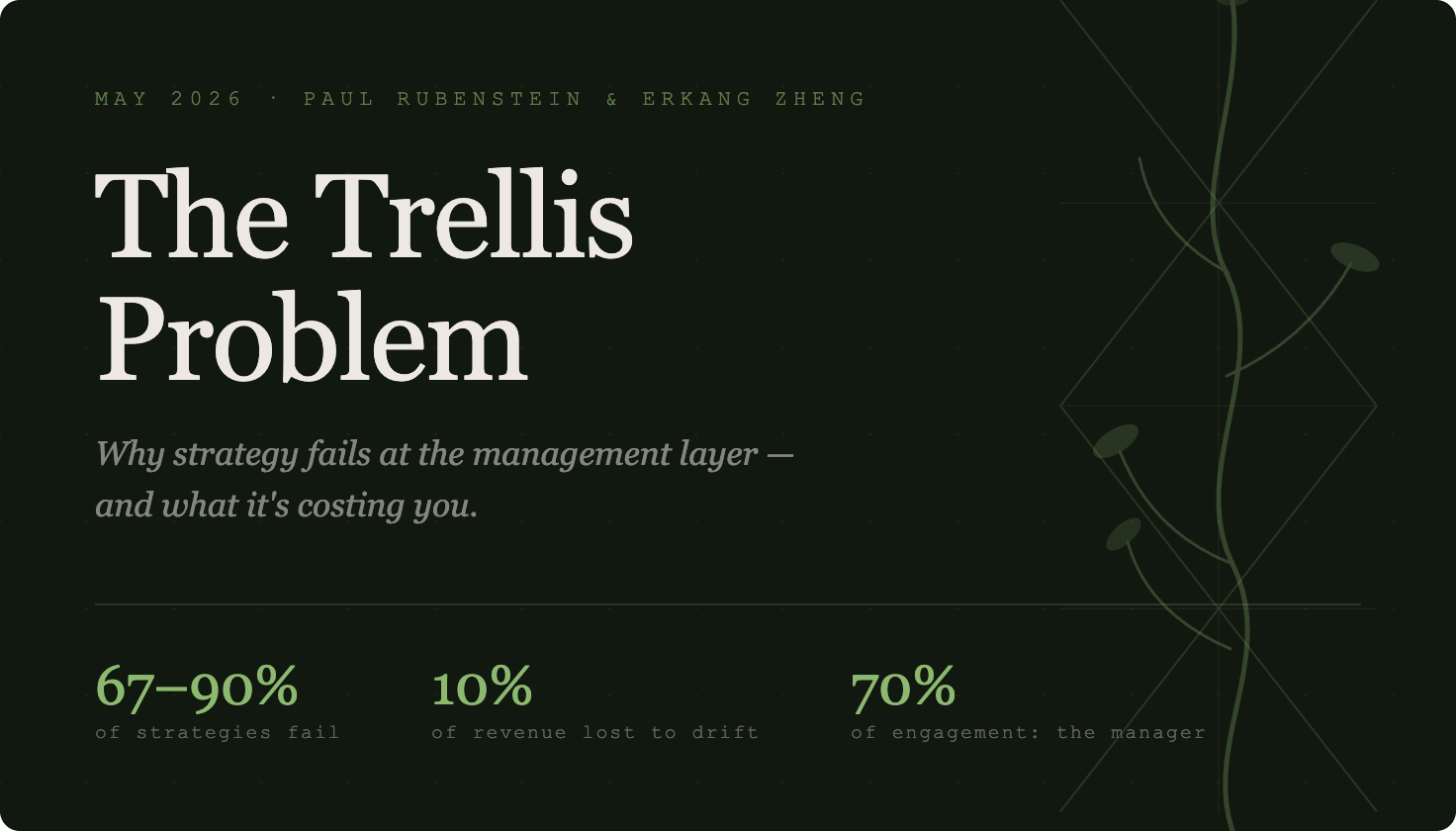
A white paper on strategy execution, the overwhelmed manager, and a new operating system for work.
By Paul Rubenstein & Erkang Zheng · Originally published on Paul Rubenstein's Substack.
The question nobody is asking
Companies have spent the past three years asking artificial intelligence to fix productivity. The more consequential question has barely been raised: can it fix alignment?
That gap may be the most expensive problem in business today. By most measures, somewhere between 67% and 90% of strategies fail, not because the strategy was wrong, but because the organization could not hold the line between intent and execution long enough for it to matter. The problem is not the plan. It is the distance between the plan and the people doing the work.
A garden without a trellis
Consider how a garden grows. Left without structure, each branch follows its own logic, reaching toward the light, competing for space, and optimizing locally. The result is growth of a kind, but not growth in a direction. A trellis changes that. It does not suppress the plant; it gives the plant's energy a shape. And crucially, it works even when the gardener is not watching.
Most organizations have no trellis. They have strategy documents, town halls, and quarterly reviews, but no persistent structure that connects daily work to stated goals. Each team, each manager, each individual contributor makes reasonable decisions within their local context, and those decisions accumulate into something that only vaguely resembles the plan.
This is not a failure of leadership. It is a failure of infrastructure.
No organization has a chief silo-breaking officer. Nobody is dismissed for poor cross-team collaboration. The friction is treated as an acceptable cost of operating at scale, like weather: complained about but not expected to change. The data suggest otherwise. According to the Economist Intelligence Unit, "61% of firms say they struggle to bridge the gap between strategy formulation and day-to-day implementation, and 30% identify failure to coordinate across units as their single greatest challenge." Research published by In Parallel estimates that the cost of strategic misalignment is 60% of wasted resources, with poorly managed strategy execution costing companies up to 10% of annual revenue.
A $10bn enterprise could be losing $1bn a year to a problem nobody owns.
Why every tool built to solve this has failed
The market has not ignored the problem. It has simply failed to solve it.
OKR platforms arrived with a compelling premise: align goals from the top of the organization down to individual contributors and watch execution improve. What happened instead was that OKRs became departmental goals. They reinforced the silos they were designed to dissolve, proved too rigid for the pace at which strategy actually needs to move, and required enough manual upkeep that most organizations quietly abandoned the discipline of keeping them current.
Engagement software tried a different approach: measure workforce sentiment and use it as a proxy for organizational health. But sentiment is variable. It shifts with individual manager relationships, personal circumstances, and factors only partially within a company's control. Measuring how people feel is not the same as measuring whether the work is aligned. By the time disengagement appears in a survey, the underlying problem has been compounding for months.
Weekly status reports are tiresome and editorialized. Nobody writes a status report saying they spent three days on work unrelated to the company's top priority. Time-tracking is cumbersome and resented.
Every one of these tools produced lagging indicators, signals that arrived after the misalignment had already done its damage. Profit and loss attainment tells an organization what happened. It does not say why or what to do before the next quarter becomes this quarter.
The consistent lesson buried in decades of failed execution software is this: the problem was never a shortage of data. It was a shortage of the right signal, in real time, in the flow of work, without friction. What was missing was not better measurement but earlier measurement: a way to detect the moment an organization begins moving away from its stated direction, before the gap between intent and execution becomes the gap between plan and result.
What has changed
The conditions that made this problem hard to solve have shifted materially.
The digital capture of work is now rich and growing richer. Meeting audio is transcribed. Emails, documents, and collaboration tools create a continuous record of how work actually unfolds. Platforms like Slack, Teams, and every major project management system generate a detailed picture of where attention goes, what gets prioritized, and what gets set aside.
The social contract around this has also changed. Passive signal capture once felt invasive. Today it feels convenient, because people have seen the payoff: better tools, fewer redundant meetings, less administrative friction. The question is no longer whether to use this data. It is what to do with it.
What this makes possible, for the first time at scale, is strategic drift detection: the ability to observe, in near real time, when the daily decisions of a team or an individual are diverging from the priorities an organization has committed to pursuing. Drift is not failure. It is the early signal that precedes failure. And it is the signal that every existing tool (surveys, reports, QBRs, OKR platforms) has consistently arrived too late to provide.
Combining the digital footprint of an organization's daily work with the digital footprint of its strategy, the goals, priorities, and operating principles that senior leaders have articulated, makes something new possible. Not just measuring activity, but measuring alignment.
The AI investment problem
The failure of most AI investments follows a similar pattern to the failure of most strategy execution tools: organizations have been solving the wrong problem.
According to Wharton research, "AI deployment surged 400% across enterprises between 2024 and 2025. Yet only 12% to 18% of companies captured meaningful returns." McKinsey found that "organizations seeing significant gains from AI were twice as likely to have redesigned their end-to-end workflows before selecting models." The transformation work comes first; the technology follows.
Most AI spending has gone toward making individual contributors faster: copilots, assistants, and tools that reduce the time it takes to do a task. This is useful, but it is a narrow application. A faster organization that is misaligned is still misaligned. The bigger opportunity lies elsewhere: using AI to improve how distributed decisions compound toward, or drift away from, a shared outcome.
Cost reduction creates a temporary advantage. Competitors can replicate it. Execution capability, embedded in the operating rhythm of an organization, is harder to copy and more durable in its effects.
The manager is the last mile
There is a specific person at the center of the execution problem, and that person is under considerable strain.
According to Gallup, "70% of the variance in team engagement is determined by the manager, not the chief executive's vision, not the company's stated values, but the direct relationship between an employee and their immediate supervisor." The manager is the execution layer. Every strategy, however well designed, passes through this person before it reaches the work.
That person is increasingly overwhelmed. Gartner found that "75% of HR leaders believe managers are already struggling with expanding responsibilities, and 69% say managers lack the skills to lead change effectively." Structural changes are making this worse: between September 2023 and April 2025, the average manager's span of control grew by 16.6%, according to Pave, as organizations used AI to remove layers of middle management. More direct reports, less time, the same expectations.
The results appear in the data. According to Beekeeper, "65% of frontline leaders believe they have effective communication strategies; only 35% of their employees agree." According to the Achievers Workforce Institute, "half of HR leaders say they provide quarterly manager training, but only a third of managers agree."
The best manager in the world cannot hold alignment across a growing team without visibility into where the work is actually going. They rely on the same editorialized reports and obligation-driven check-ins that have always felt like overhead. The system is not built for them. It is built around them, which is a different thing entirely.
The trellis, made digital
It's time to harness AI and create tools (like Ariso) that are designed to close this gap. The core approach is to take a company's strategic framework, whatever it is, and make it digital in a way that the organization can actively monitor.
An executive team that has adopted a McKinsey operating framework can describe it within the system and track alignment against it across all teams. A company running on OKRs can embed them and let the platform do the work of connecting daily decisions and communications back to stated goals. Organizations with proprietary frameworks built over years of operating experience can bring those in, too. The platform provides a structured starting point and enough flexibility to reflect how a given company actually thinks.
The AI then does what no spreadsheet, survey, or status report can do at scale. It connects strategic intent with the distributed information flowing across the organization: messages, meeting notes, project updates, and documents. It surfaces, for every manager and every individual contributor, whether their work is moving toward the company's goals or quietly departing from them. This is drift detection made operational: the gap between stated strategy and actual work, measured continuously rather than reported quarterly.
This is not surveillance. Surveillance is about catching people doing something wrong. Context is about helping people understand whether they are pointed in the right direction and giving leaders early warning before the drift becomes a problem. The distinction matters, particularly as organizations ask employees to accept a richer digital footprint of their work.
The payoff is visibility in both directions. Managers gain context without asking for it. Leaders see misalignment before it shows up in the numbers. Employees, perhaps for the first time, have a clear, real connection between their daily work and the organization's actual priorities.
What does this change in practice?
For the executive team, the shift is from managing by lagging indicators to managing by leading indicators. A system that detects strategic drift as it develops, at the team level, before it aggregates into a planning-cycle problem, gives leadership something it has rarely had: early warning at the point where intervention is still inexpensive. Profit and loss attainment, weekly reports, and quarterly reviews will always exist, but they describe the past.
For the middle manager, the shift is from relying on informal signals and gut feel to having structured visibility into where their team's attention is going and how it connects to what the organization has said it wants. This does not replace management judgment; it improves the inputs to that judgment.
For the individual contributor, the shift is from operating without knowing whether their work matters to having a direct and visible connection between what they do each day and where the organization is trying to go. Clarity about contribution is one of the more reliable drivers of engagement and retention.
For the organization as a whole, the shift is from treating strategic misalignment as an unavoidable cost of scale to treating it as a solvable problem. The trellis scales with the organization. Strategy finally has a nervous system.
The competitive case
Capital is not a differentiator. It can be raised. Technology can be rented. Supply chains can be outsourced. The question facing every senior leadership team is what, beyond these inputs, actually separates organizations that execute consistently from those that do not.
The answer has always been the same: the alignment and compound effect of thousands of small decisions made by distributed teams, across every level of the organization, every day. That is the last frontier of competitive advantage, and it has been hard to measure, harder to see, and nearly impossible to manage in real time.
The conditions that made it hard have changed. The tools to act on those conditions now exist. The organizations that move first will not simply improve their next planning cycle. They will build an execution capability that compounds over time, and that is not something a competitor can acquire and deploy in a quarter.
Ariso is a strategy operating system that connects organizational intent with the flow of work, providing the visibility, alignment, and leading indicators that management teams have always needed and rarely had.
Paul Rubenstein is a recognized leader in people analytics and the future of work. He was previously Chief Customer Officer and Chief People Officer at Visier.
LinkedInReady to try Ari?
The AI player-coach that gives every employee the tools to lead themselves.