
When Markets Move and You Don't: Stuck Isn't Talent, It's Your OS

Competitors are shipping, the category is heating up, and the market is moving—but your curve is flat. The default diagnosis is "we need better talent." In most cases, that's wrong.
"Stuck" is rarely a skills problem; it's a system problem.
Your organization's operating system - mindset, culture, cadences, decision hygiene, role clarity, and how work actually moves - determines throughput. With a broken OS, even A‑players stall; with a solid OS, average players produce exceptional velocity.
What "stuck" looks like in the wild
- Growth lags the market - category expands but your revenue/usage line is flat or trailing peers.
- Decisions bounce or stall - topics revisit weekly; escalation is ad hoc; nobody knows who decides.
- Meetings multiply, clarity doesn't - calendars fill, agendas don't compound, action items evaporate.
- Rework and redo - handoffs drop context; priorities churn; initiatives die in the seams.
- Leadership bandwidth goes to firefighting - coaching and development atrophy.
- ICs have no maker time or are building the wrong things - >50% meeting weeks become normal; context switching is the tax; more time fixing than innovating.
If any two of these are present, you don't have a hiring problem—you have an operating system problem.
The real root causes (not skills)
- Mindset: fear‑based, perfection over progress, consensus as default.
- Culture: low psychological safety, weak feedback loops, hero culture over team habits.
- Discipline: no operating cadence; too many WIP items; owners and dates are optional.
- Org design: wrong people in the wrong seats; role creep; unclear swim lanes; incentives misaligned.
- Decision hygiene: no clear DRI, criteria, or SLA; decisions become zombie debates.
- Time/energy drains: meeting debt, tool sprawl, context switching, status reporting theater.
These are people problems, but not talent problems; they are how‑we‑work problems.
A fast diagnostic: score your OS (0–2 each)
I've used versions of this scorecard throughout my own journey -- founding JupiterOne, scaling through hyper-growth, managing through all sorts of ups and downs, and now building Ariso. Every stage surfaces different gaps. The point isn't perfection; it's knowing where you stand so you can improve deliberately.
It's actually not that complicated. Create a heatmap across six dimensions; anything <8/12 needs attention.
- Clarity & Alignment
- Is there a north star, and a single goal that truly matters this quarter with explicit constraints?
- Do teams see how their work ladders to it, with measurable OKRs that are actually tracked?
- Ownership & Accountability
- Do decisions and outcomes have clear owners (not activities), with explicit handoffs (start/finish lines) as needed?
- Are the right people in the right seats -- roles defined by outcomes, scope aligned to strengths, and underperformers addressed within a quarter?
- Process & Cadence
- Do you run a weekly/biweekly review and a retro that produces real changes?
- Does the rhythm produce decisions and unblock work or just generate status updates?
- Velocity
- Do P1 decisions resolve within an SLA (e.g., 24–48 hours) or escalate automatically?
- What's the cycle time from "idea approved" to "value shipped", and is it getting shorter?
- Load & Focus
- Do people (both ICs and managers) have enough maker time, or are calendars consumed by meetings and status updates?
- Do priorities stay stable through a sprint with WIP limits enforced, or does constant churn and overload scatter attention?
- Mindset & Safety
- Is there psychological safety: do people raise issues, give upward feedback, and admit mistakes without fear?
- Is the org adapting: addressing issues, removing blockers, experimenting with new tools and ways of working (e.g., AI), or defaulting to "how we've always done it"?
A word on "focus":
Everyone nods at focus, but few operationalize it.
The hard part about focus is making it concrete. The first five dimensions create the conditions; these questions measure whether focus is actually happening.
Quick metrics to pull:
cycle time to value; decision SLA compliance; PR review time; WIP/person; rework rate; IC meeting %; number of handoffs per deliverable, meeting-to-making ratio.
Artifacts to inspect:
strategy one‑pager, org map, role charters, quarterly plan, RACIs, weekly review/retro notes, action tracking, employee feedback, calendar audits.
📥 Download the Workbook
Want to run this diagnostic for your team? Download the interactive workbook to score your organization's operating system.
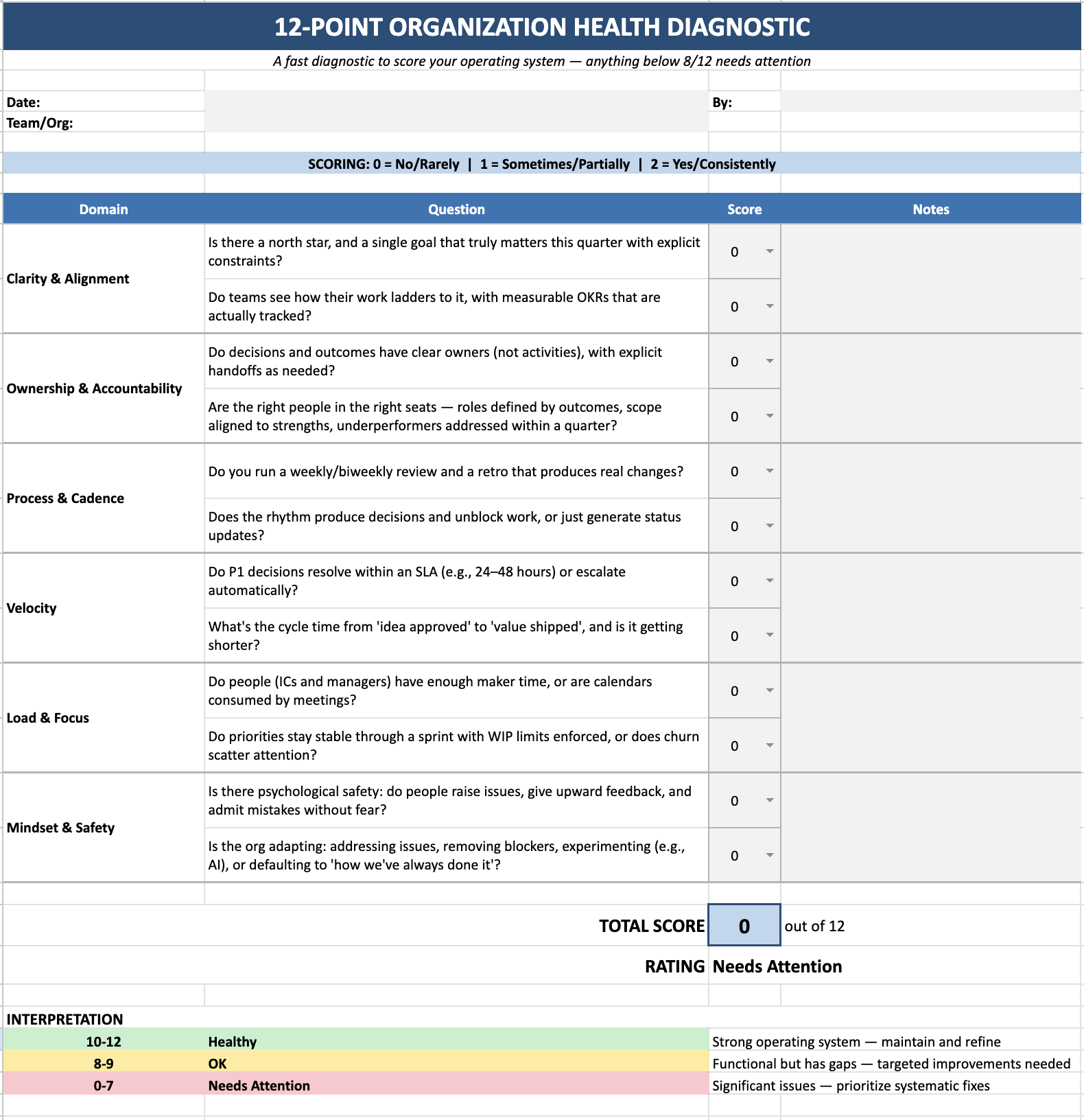
Download the 12-point Org Health Diagnostic Worksheet →
Where to start: prioritizing root causes
If you score low on multiple dimensions, don't try to fix everything at once. Use these heuristics:
- If calendars are drowning people (Load/Focus score ≤1): Start with meeting relief. People can't think about decision hygiene or role clarity when they have no time to think at all. Cut meetings first, then address what surfaces.
- If decisions keep bouncing (Velocity score ≤1): Fix decision rights before cadences. Weekly reviews won't help if the same topics reappear because nobody knows who can actually decide.
- If goals are unclear or conflicting (Clarity score ≤1): Start here. WIP limits and meeting discipline are meaningless if people aren't sure what work matters. Name the one goal before optimizing how work flows.
- If people don't feel safe raising issues or experimenting (Mindset score ≤1): This blocks everything else. You can't diagnose accurately if people are hiding problems. Create safety before demanding accountability.
General rule:
Fix the constraint that's upstream of the others. Clarity enables ownership. Ownership enables cadence. Cadence enables velocity. Safety enables honesty about all of it.
The 30‑60‑90 fix‑it playbook
This is about compounding behaviors, not heroics.
0–30 days: Stabilize
- Gather brutally honest feedback—from employees, customers, partners, lost deals. You can't fix what you won't name. Anonymous surveys, skip-levels, and win/loss interviews surface patterns that leadership often can't see.
- Name one company goal for the quarter and kill/park work that doesn't ladder to it.
- Establish decision DRIs + SLA with a simple decision template (context, options, criteria, call). The SLA only works if everyone agrees on what constitutes a P1 and who has authority to decide—clarify both.
- Prune 25–30% of meetings. Keep meetings that produce decisions or unblock work; cut status updates (replace with async) and "alignment" sessions with no clear output. Default to 25/50‑minute blocks.
- Start a weekly review (business outcomes + blockers) and a retro (behavior/process improvements).
- Instrument 4–6 OS metrics to get baseline (decision SLA, WIP/person, IC meeting %, rework rate).
31–60 days: Accelerate
- Right seats, right people: tighten role charters; align scope to strengths; remove role creep.
- Implement the meeting lifecycle: prep with context → capture decisions/actions → push to where work lives → follow‑through → bring forward unfinished business automatically.
- Set WIP limits at team and individual levels; make trade‑offs explicit. This requires political capital—telling leadership "we need to do fewer things" only works with strong trust or a burning platform. Be ready to defend the constraint.
- Standardize decision records and publish them where teams can find and reuse them.
61–90 days: Scale and sustain
- Install the manager operating system: structured 1:1s, scorecards, coaching prompts, recognition cadence. (This deserves its own deep dive—what makes a 1:1 actually useful vs. a status check, what belongs on a scorecard, how coaching prompts compound over time. More on this in a future post.)
- Codify cadences (planning, weekly reviews, retros) and tie them to metrics and nudges.
- Automate follow‑ups; remove manual status theater; make the default path the high‑leverage path.
- Run a quarterly "stuck" audit using the heatmap and fresh feedback rounds; fix root causes, not symptoms.
Anti‑patterns that keep you stuck
- Hiring your way out of a broken system (adds heat, not light).
- Adding process without ownership (more steps, same confusion).
- Tool sprawl to mask clarity gaps (a new system for every problem).
- Hero culture: exceptions as standard operating procedure.
- Endless pilots with no kill criteria, and "temporary" exceptions that become permanent.
Why this matters for growth
Markets reward throughput and learning speed. If the market is moving and you're not, it's because your OS turns energy into friction rather than momentum. Fix the OS and three things change:
- Decision latency drops, cycle time shortens, and you ship more value per calendar week.
- People spend more time in their zone of strength and less time thrashing.
- Learning loops tighten—what you try turns into what you keep or what you stop, faster.
That's how you close the gap when competitors are accelerating.
Where AI can help
We're building Ari because alignment and sustained support for every person—not just a few heroes—is the unlock. Organizations get unstuck when:
- Every manager runs a reliable operating cadence (prep → 1:1s → follow‑through → recognition) without extra overhead.
- Every meeting closes the loop (decisions, owners, dates) and those actions actually move where work lives.
- Every individual sees context, clarity, and next moves at the right time—and gets nudges that help them follow through.
- Patterns surface automatically (slipped commitments, unclear ownership, recurring risks) so teams improve how they work, not just what they work on.
Ari pairs tactical assistance that removes busywork with coaching that upgrades the operating system—mindset, rituals, and decision hygiene—so people can do their best work in the seats where they fit best. No product specifics here, just the principle: better alignment, better loops, better outcomes.
Closing Thought
Don't wait until you're stuck to act. The operating system isn't a fix for broken orgs—it's the foundation for any org at any stage. Whether you're a 10-person startup or a scaling team, the same principles apply: clarity, accountability, cadence, velocity, mindset, focus.
"Stuck" isn't a talent indictment; it's an OS diagnosis. But more importantly, the right OS prevents stuck from happening in the first place. When the system compounds the right behaviors, teams move faster with less effort, managers coach more and chase less, and your curve stays where it should be—up and to the right.
Want the full assessment?
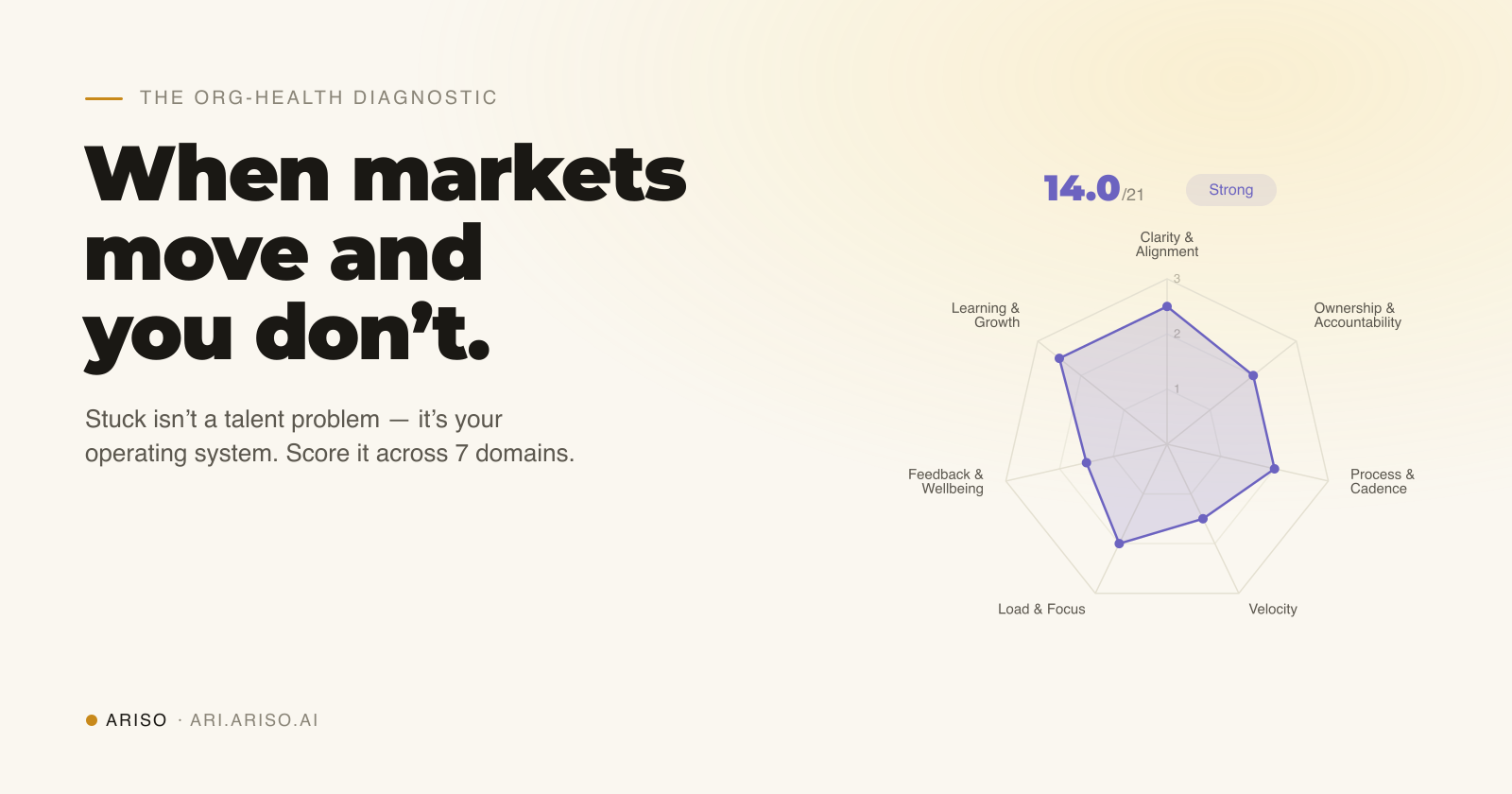
Get the complete 21-point, 7-domain Org Health Assessment Workbook with detailed scoring rubrics, benchmarks, and action planning templates.
Erkang Zheng is the Founder and CEO of Ariso. Before starting Ariso, he founded JupiterOne, and worked on security and infrastructure at several leading technology companies.
LinkedInReady to try Ari?
The AI player-coach that gives every employee the tools to lead themselves.