
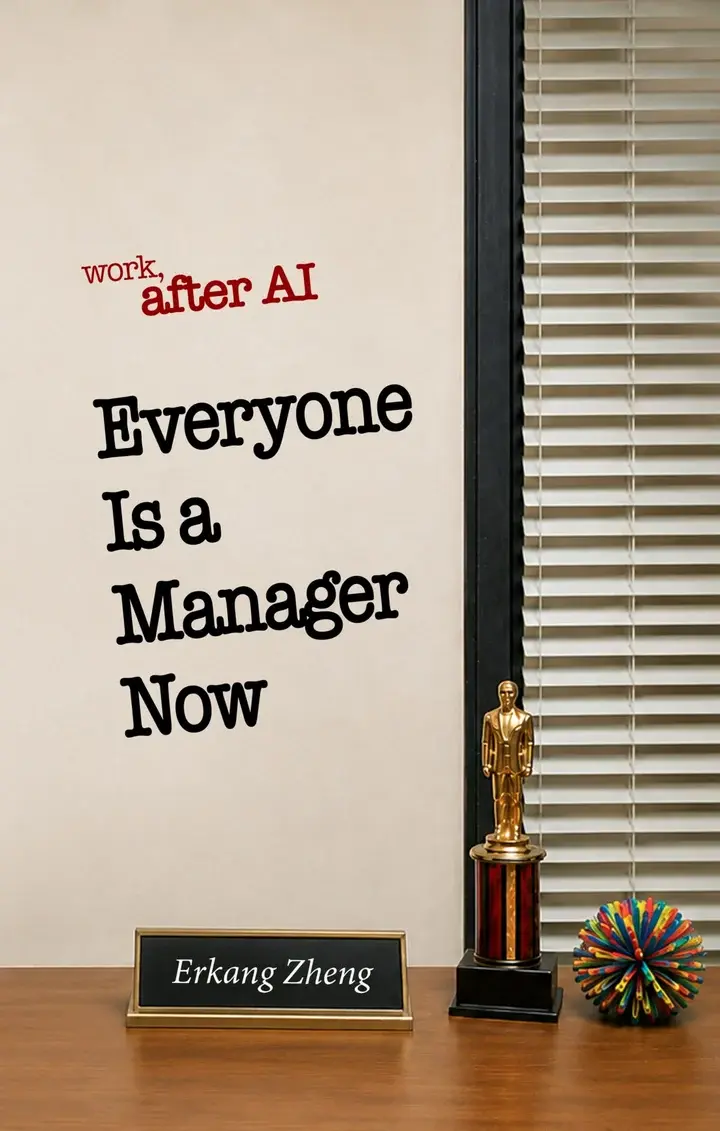
Everyone Is a Manager Now
AI is not coming for your job. It is coming for the producing part of your job — and what is left is the part we have always called management: deciding, directing, aligning, judging. A short book by Ariso’s founder, Erkang Zheng, on doing that part well.
- 100 pages
- 19 chapters
- Free PDF & ePub
- Paperback on Amazon
PDF and ePub, straight away. We’ll also keep you in the loop on Ariso — unsubscribe anytime. Privacy Policy.
Prefer paper? Get it on Amazon.
What early readers say.
“Erkang Zheng gets to the core of the future of work. Greater output of work is not the same as better performance. The advantage will not belong to whoever produces the most work with AI, but to whoever applies the best judgment to what gets produced!”
“AI isn’t simply making us more productive — it is fundamentally changing what our jobs are. Provocative, practical, and extremely timely, this is a book every leader should have on their bookshelf.”
“As the world wrestles with the future of AI, Erkang Zheng lays out a timely case for what it can and cannot do. His message is infused with guidance for the next generation of knowledge workers, leaders, and, most importantly, hope.”
“I read the entire book yesterday on the flight. Incredibly easy to read, incredibly good flow. I actually highlighted a number of sections that stood out to me as things I would enjoy using going forward in my own meetings and discussions.”
Why I wrote this.
I have watched two revolutions from the inside. The first moved me across an ocean. The second is moving all of us, right now, whether we booked the ticket or not.
This is a small book on purpose. You can finish it on a flight. It makes one argument: AI is not coming for your job — it is coming for the producing part of your job, and what remains is the part we have always called management. Deciding. Directing. Aligning. Judging.
Most people haven’t grasped this yet. They are using AI to produce more, faster, and wondering why nothing feels better. The unlock is not volume. It never was.
The stories here are mine — some polished by memory, a few sharpened for the telling, and some identifying details changed to protect people who never asked to be in a book. The lessons are as true as I know how to make them.
The tools at the back are real; you can skip every story and go straight to them. I won’t be offended. That would be very good management.
— EZ
19 chapters, in four movements and a coda.
The argument first, then the stories, then the playbook — and tools at the back you can use without reading any of it.
The Shift
What is actually happening, and why volume was never the answer.
- The Horse Doesn’t Get a Vote
Two hundred years of machines taking the producing — and never once the deciding. The horse didn’t get a vote. You do.
- The Notes Got Better. The Work Didn’t.
Forty-seven perfect meeting summaries and nobody followed up. The bottleneck was never production. It was coordination.
- The Machine Doesn’t Get Tired. You Do.
Three fatigues nobody warned you about: the creator’s, the audience’s, and the one where your org re-derives its own work daily at token prices.
- Everyone Is a Manager Now
Management is four questions, not an org chart. Every knowledge worker on earth just acquired a workforce — and the questions came with it.
The Journey
What it cost the author to learn what the word manager means.
- Hard, Harder
A list from the founder years. Not one of the “harder” items is a production problem. Your career lives on the second list.
- Tell People
TRAM — track, report, align, measure. The drivetrain between effort and outcome, and the one habit worth more than talent.
TRAM in the Ariso Framework → - The Trillion-Dollar Tax
Three teams rowing hard in three directions, every dashboard green. Misalignment doesn’t live in the teams. It lives in the seams.
- Straddling Paradoxes
Confident at nine, humble at eleven, urgent at two, patient at four. A machine optimizes. A manager straddles.
- When There Is Doubt, There Is No Doubt
Deciding is the last thing that cannot be delegated. An agent cannot be accountable — accountability is not information, it is skin.
The Playbook
The mechanics. Start Monday.
- Not a Tool
The $449 scam the author personally forwarded, and the agent that caught it unasked. Stop treating AI as a tool. Treat it as a new hire.
- Your First Direct Report Isn’t Human
Six habits: staff, specify, delegate, review, calibrate, cadence. Every individual contributor who says “faster to do it myself” is a first-time manager grabbing the keyboard.
- No Tickets
Standups with no yesterday. A ticket is a memo about work that begins lying the moment it’s written. Automate the memory; keep the steering.
- Manage Yourself First
The prior report on your org chart is you. Reinvent every two years, show up prepared, and run a fifteen-minute honest loop.
For the Leaders
What happens to the org, the metrics, and the middle.
- The New Org
The pyramid was a coordination workaround, and the workaround is ending. Stop counting what your people produce. Count what they decide.
- The Trellis Problem
Two tomato plants, same sun, same rain. One got a trellis. Drift is not an event — it’s a rate, and you’ve been sampling it quarterly.
- The Annual Everything Is Dead
The performance review is a compliance audit of a human being. It proves what audits prove: that someone prepared for it.
- So What Happens to the Managers?
The job is splitting in half. The relay half is being automated. The coaching half just became the whole job.
Coda
The argument, stress-tested — and the reason for all of it.
- What If I’m Wrong?
The strongest objections, stated as well as the author can state them, plus three of his most expensive failures told plainly.
- Impossible Until It’s Done
Management used to be a private condition. It is becoming a shared one, and people who share a condition find it very hard to stay strangers.
Two futures are being built with this technology. They do not differ in their models. They differ in their verb.
The book makes the case. The framework puts it to work.
Chapter six, Tell People, is about TRAM: track, report, align, measure — the habit between effort and outcome. The Ariso Framework grew out of it. TRAM is its How, between a Why (intrinsic motivators and growth mindset) and a What (CLEAR organizations), and everything Ari does is built on the three.
The book’s tools, as free field guides.
The book ends with tools you can copy. Here they are worked out in full — templates, prompts and kits — each from the chapter that argues for it.
- The CLIBuild your own chief of staff
A private, file-based chief of staff you run in Claude Code — the TRAM loop as a folder of markdown.
From chs. 6, 10–11
- The DiagnosticAssess your org health
A prompt pack that turns Claude into an org-health analyst — feed it your data, get the 21-point scorecard and spider chart.
From chs. 7, 14, 16
- The Product SpecBuild the TRAM work OS
The hand-it-to-Claude-Code build spec for a personal AI work OS — vision, a legible data model, a full prompt pack, and a phased build plan.
From chs. 6, 11
- The TemplateBrief agents like a manager
A one-page delegation brief — intent, context, constraints, definition of done, review plan. Brief a machine the way you’d brief a bright new hire.
From ch. 11
- The RitualThe manager-of-one weekly review
A fifteen-minute weekly review on the FIT loop — Feel, Inventory, Target. The 1:1 you owe the first report on your own org chart.
From ch. 13
- The ManualWrite your user manual
One honest page about how to work with you — how you decide, how you take bad news, what your silence means — plus an extended version, the prompts to draft it, and the habit of reading each other’s.
From ch. 6
- The Upward LoopManaging up through the transition
For the manager whose boss still wants the deck: a map of the seat above you, a five-line weekly upward note, and seven scripts for selling the record upward.
From ch. 17
Dispatches from the practice
Essays from the people whose work the book describes.
Read it on your next flight.
One argument, and the tools to act on it Monday morning.
PDF and ePub, straight away. We’ll also keep you in the loop on Ariso — unsubscribe anytime. Privacy Policy.
Prefer paper? Get it on Amazon.
Want the loop run for you? Start free with Ari.