
How Ariso Runs SOC 2 Compliance as a Team, with Ari

Most SOC 2 work isn't hard, but there's a lot of it, and it's spread across everyone: engineering owns access reviews and change management, operations owns vendors and onboarding, and leadership owns policies and risk. Compliance usually fails through dropped handoffs, not through a missing control.
So we run it like any cross-functional project: one team, one channel, Drata as the system of record, and Ari keeping the work moving. This guide walks through the setup using our CLEAR framework: Clarity, Leverage, Evolution, Alignment, Rigor.
Start with a project, not a checklist
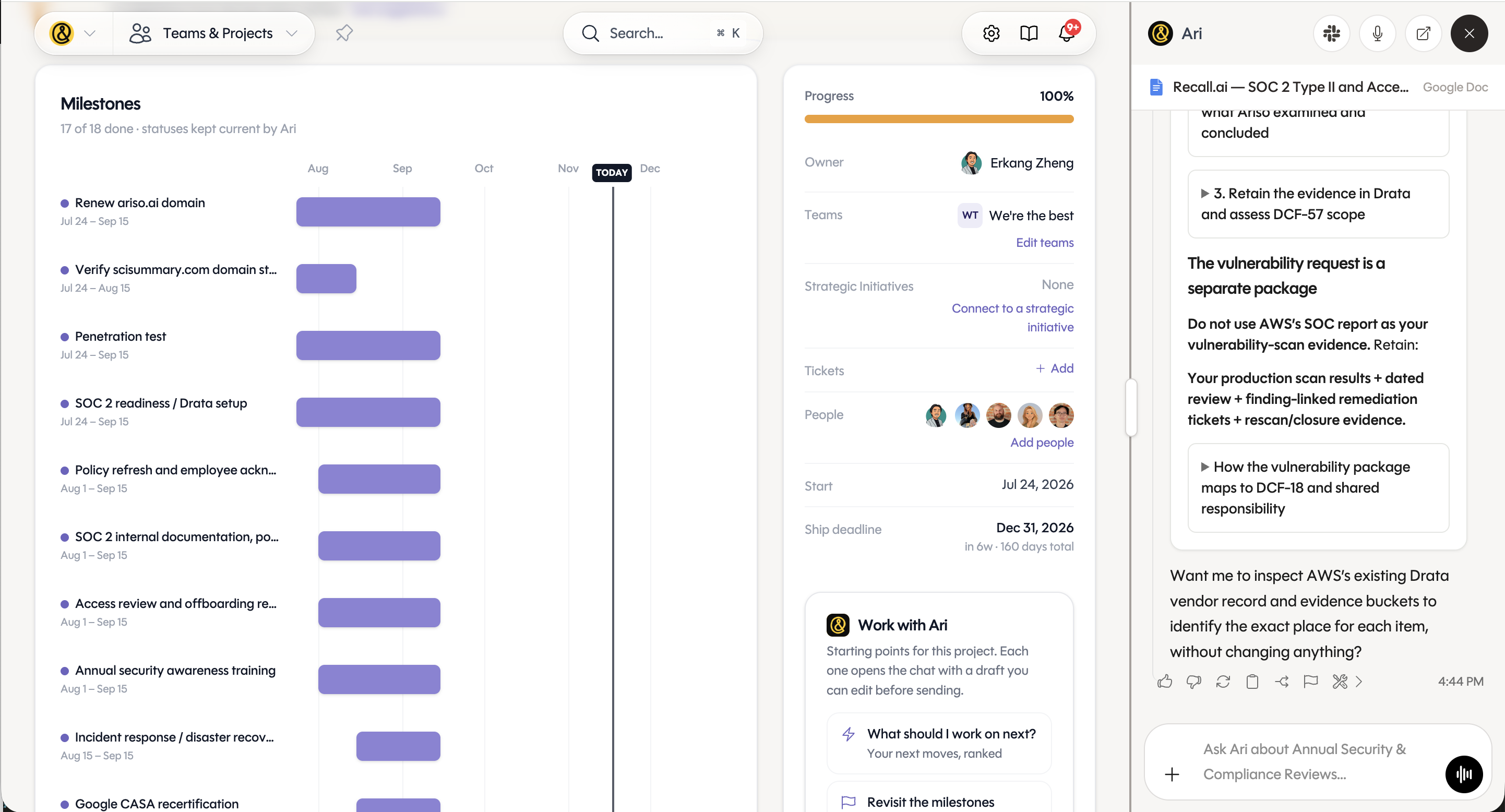
Before touching a control, create a SOC 2 project in Ari with a goal you can measure:
- Goal: audit-ready for the observation window by a fixed date.
- Milestones: policies approved, controls implemented, monitoring tests passing, evidence collected, auditor fieldwork, auditor feedback.
- Measures: controls ready vs. total, failing monitoring tests, open evidence requests, overdue tasks.
A checklist tells you what's left. A project tells you whether you'll make the date.
C — Clarity: one source of truth
- Drata holds the facts: controls, policies, monitoring tests, personnel and device compliance, vendors, and evidence. No shadow spreadsheets.
- One channel holds the conversation. Questions, decisions, and status go in
#security, not DMs. - The project holds the plan. Every todo links to a milestone, so "are we on track?" has one answer.
Ari sits in the channel with read access to Drata, so questions like "Which controls are still missing evidence for change management?" get answered from Drata instead of someone digging through it.
L — Leverage: delegate to people, agents, and Ari
Most compliance work is collecting and routing information. Hand that off:
- Ask Ari to act, not just answer. Summarize this week's failing tests, draft a vendor review, or create a Drata task for a control's owner. Ari also spots patterns: controls with a shared root cause, failures new since last week, evidence that expires before fieldwork.
- Let Ari check systems from your browser. Many controls are easiest to verify in an admin console. With the Ari Browser Companion Chrome extension, Ari works in tools you're already signed in to. For an access review, it reads the user lists in your identity provider, GitHub, and cloud console, compares them with the HR roster, and reports departed users, unexplained admins, and missing sign-offs. Every action is logged, and you can pause it at any time.
- Give engineering gaps to coding agents. Branch protection, encryption at rest, IAM policies, and audit logging are code changes. We hand each one to Claude Code or Codex, and ari-hooks reports their progress back to the project. When the PR merges and the Drata test turns green, the todo closes.
Every delegated item, to a person, an agent, or Ari, is a todo with an owner and a due date. That's what keeps leverage from turning into dropped handoffs.
E — Evolution: fix the process, not just the evidence
When a passing Drata test fails again, Ari flags it in the channel with what changed. Ask whether it's a one-off or a process gap. Two fixes we made:
- Offboarding kept missing a step, so we added it to the HR checklist.
- Evidence screenshots kept going stale, so we replaced them with automated tests wherever Drata supports one.
Treat the project plan as a living document; Ari proposes changes when the measures drift.
A — Alignment: clear ownership, shared visibility
- One owner per control, named in Drata and on the project.
- Status is public in the channel, so nobody is surprised in a stand-up.
- Asks are specific. "Upload your device encryption screenshot by Thursday" beats "compliance is behind."
Ari sends the reminders, so teammates don't have to nag each other, and everyone sees the same data.
R — Rigor: keep a steady cadence
An audit window is long. Three habits carry it:
- Weekly progress report. Ari posts controls ready, tests failing, evidence outstanding, what's at risk, and who's blocked.
- Time on the calendar. Ari finds a free slot for each owner's next task, e.g. "You have 45 free minutes Thursday at 2pm. Want to block it for the access review?"
- Email triage. Auditor requests, vendor SOC reports, and Drata notifications become todos on the right milestone, and the owner is pointed to them.
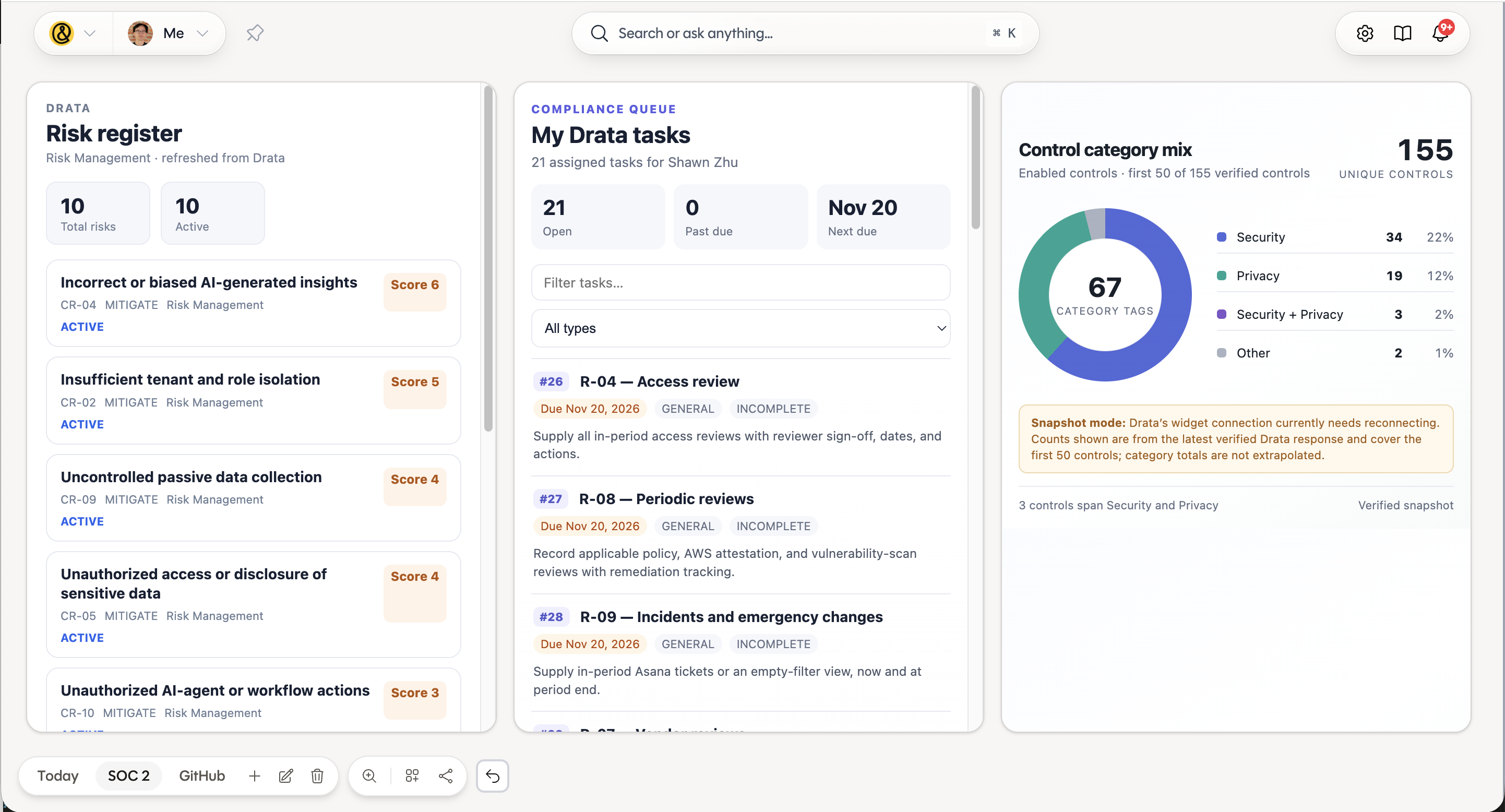
For a quick read, ask Ari for dashboard widgets built from Drata, such as the risk register, each owner's task queue, and control coverage, and pin them to a shared dashboard. Leadership checks the dashboard instead of calling a status meeting.
Example prompts
Ask Ari the way you'd ask a teammate. Two we use:
Create one todo under the milestone "Auditor feedback" for each row in this spreadsheet: https://docs.google.com/spreadsheets/d/…
Ari creates a todo per auditor finding and links each one to the milestone, so every finding has an owner, a due date, and a place in the weekly report.
Create a review report of user access to the OpenAI platform based on control DCF-xxx, and save it as a Google Doc.
Ari reads the control's requirements in Drata, checks the OpenAI platform's members in your browser against the roster, and writes the report (who has access, at what role, what changed, what needs follow-up) for a reviewer to sign off and attach as evidence.
Why this works
Ari acts as the security manager in the middle. Compliance information lives in Drata, spreadsheets, tickets, each system's settings, and people's heads. Ari has access to all of them, moves information between them, and keeps each owner informed until the work is done.
Ari can do the work, not just track it. With the expertise and the access, it drafts access reviews, vendor assessments, policy updates, and auditor responses, and runs internal audits that check each control against its evidence. People make the judgment calls and sign off on a finished draft instead of a blank page.
The takeaway
SOC 2 is a coordination problem more than a document problem. Drata holds the controls and evidence, a shared channel holds the conversation, and a project with a measurable goal tells you whether you're on track. Ari connects them, so people and agents move toward the same date. The same setup works for any long, cross-functional effort where no single person holds the whole picture.
Ready to try Ari?
The AI player-coach that gives every employee the tools to lead themselves.